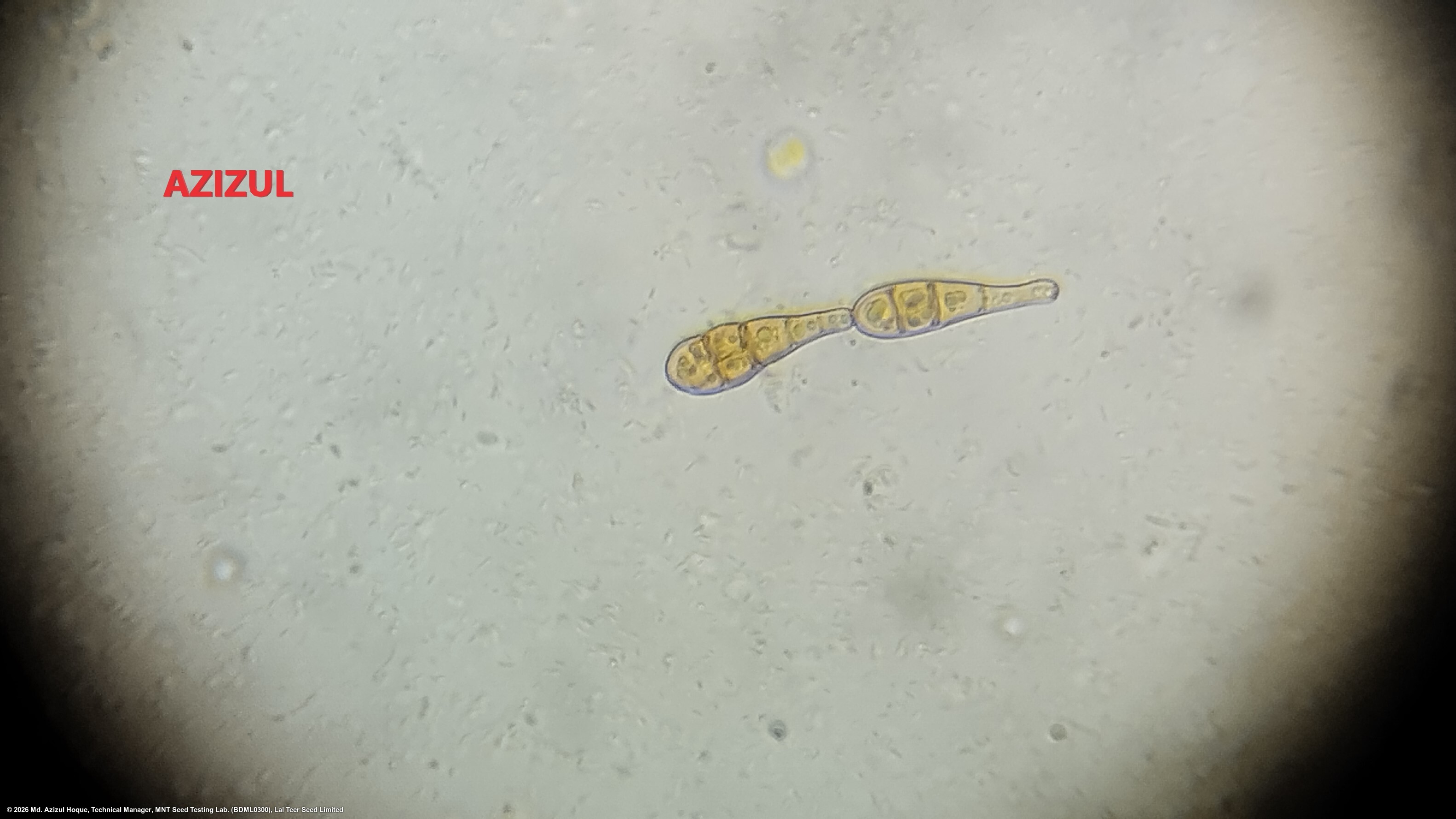
Alternaria alternata on Oryza sativa
Image credits: Md. Azizul Hoque, Technical Manager, MNT Seed Testing Lab. (BDML0300), BD
Morphological Description: Organism Identification: The specimen exhibits morphological characteristics consistent with the genus Alternaria. Spore Type: Multicellular conidia. Shape: Obclavate to pyriform (club-shaped) with a prominent apical beak (tapered end). Septation: The conidia are muriform, possessing both transverse and longitudinal septa. Arrangement: Spores are observed in catenulation (forming chains), connected by the beak of one spore to the base of the next. Coloration: Naturally pigmented (dematiaceous), showing a characteristic golden-brown to olivaceous hue.
sterilisation: NA NA | growth time: 7 days | temperature: at 22±2°C | lighting: alternating 12 h darkness & 12 h light. | plate size: 110mm | agar: Blotter Method ( ) |
DNA testing: NA
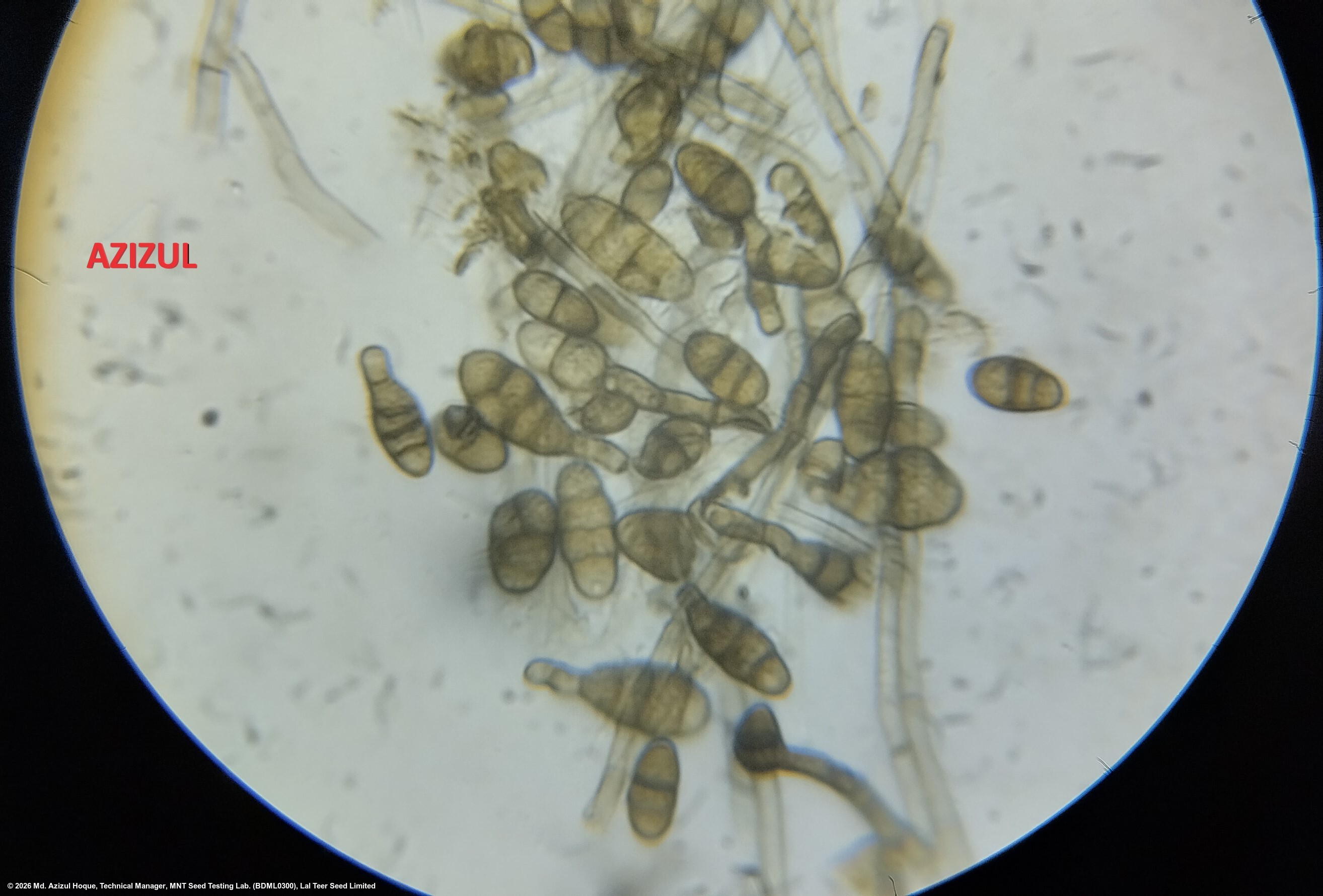
Alternaria alternata on Oryza sativa
Image credits: Md. Azizul Hoque, Technical Manager, MNT Seed Testing Lab. (BDML0300), BD
Morphological Description: Organism Identification: The specimen exhibits morphological characteristics consistent with the genus Alternaria. Spore Type: Multicellular conidia. Shape: Obclavate to pyriform (club-shaped) with a prominent apical beak (tapered end). Septation: The conidia are muriform, possessing both transverse and longitudinal septa. Arrangement: Spores are observed in catenulation (forming chains), connected by the beak of one spore to the base of the next. Coloration: Naturally pigmented (dematiaceous), showing a characteristic golden-brown to olivaceous hue.
sterilisation: NA NA | growth time: 7 days | temperature: at 22±2°C | lighting: alternating 12 h darkness & 12 h light. | plate size: 110mm | agar: Blotter Method ( ) |
DNA testing: NA
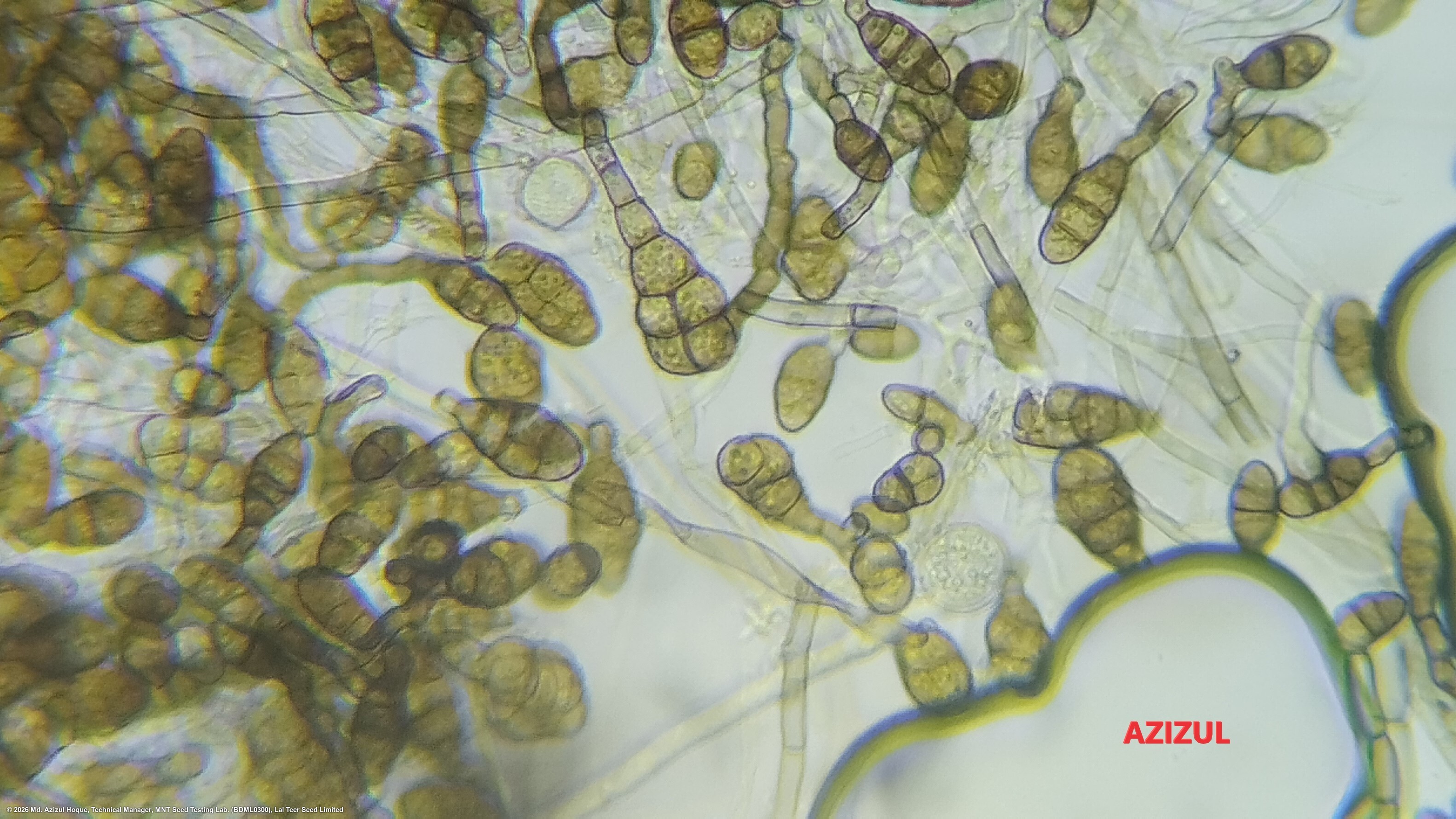
Alternaria alternata on Oryza sativa
Image credits: Md. Azizul Hoque, Technical Manager, MNT Seed Testing Lab. (BDML0300), BD
Morphological Description: Organism Identification: The specimen exhibits morphological characteristics consistent with the genus Alternaria. Spore Type: Multicellular conidia. Shape: Obclavate to pyriform (club-shaped) with a prominent apical beak (tapered end). Septation: The conidia are muriform, possessing both transverse and longitudinal septa. Arrangement: Spores are observed in catenulation (forming chains), connected by the beak of one spore to the base of the next. Coloration: Naturally pigmented (dematiaceous), showing a characteristic golden-brown to olivaceous hue.
sterilisation: NA NA | growth time: 7 days | temperature: at 22±2°C | lighting: alternating 12 h darkness & 12 h light. | plate size: 110mm | agar: Blotter Method ( ) |
DNA testing: NA