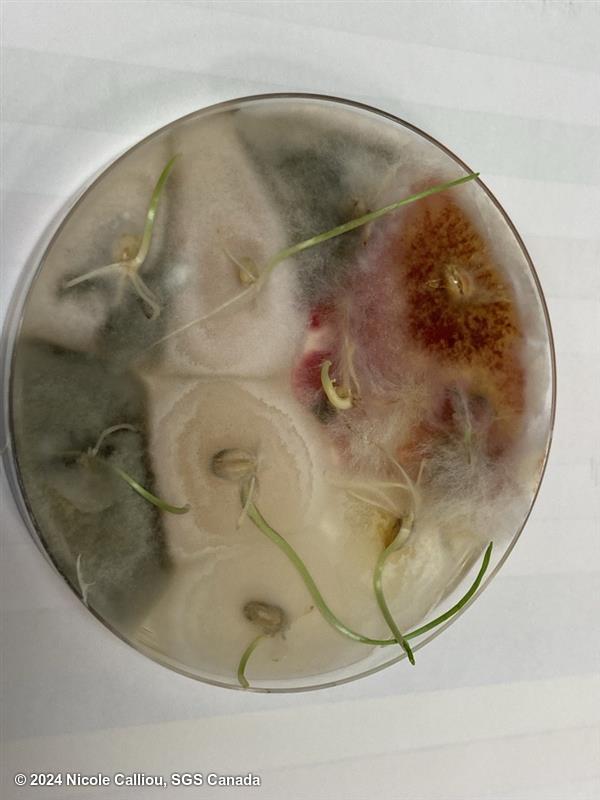
Fusarium cerealis on Triticum spp.
Image credits: Nicole Calliou, CA
Fusarium crookwellense is often confused with F. culmorum (due to their growth habits, and wide spores), but the spores should have a distinct foot cell, that is absent with F. culmorum. Also, they tend to be 5-7 septate (not 2-5 septate like F. culmorum).
sterilisation: 1% NaOCl 4 min | growth time: 5 days | temperature: 25+/-2C | lighting: 3:1 (fluorescent:nUV), within 60cm of light. Alternating light/dark in 12 hr intervals | plate size: 100mm | agar: PDA ( Neogen)
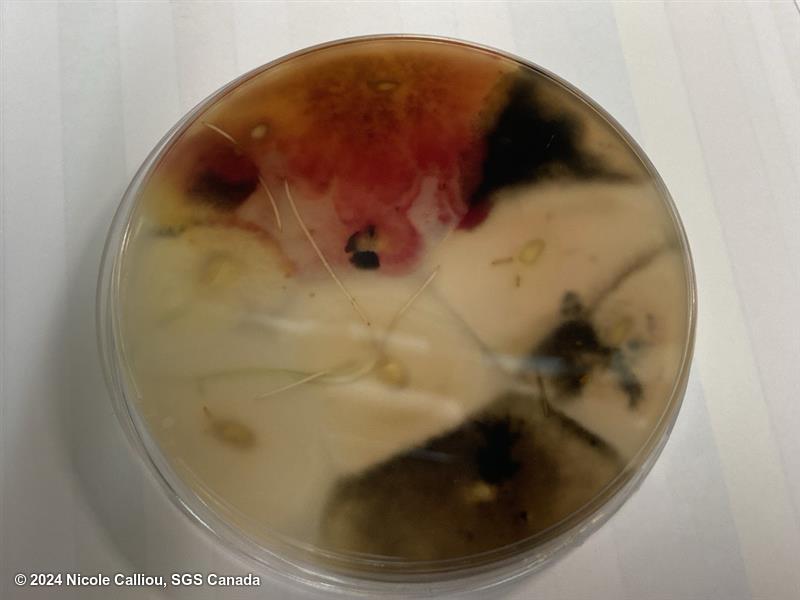
Fusarium cerealis on Triticum spp.
Image credits: Nicole Calliou, CA
Fusarium crookwellense is often confused with F. culmorum (due to their growth habits, and wide spores), but the spores should have a distinct foot cell, that is absent with F. culmorum. Also, they tend to be 5-7 septate (not 2-5 septate like F. culmorum).
sterilisation: 1% NaOCl 4 min | growth time: 5 days | temperature: 25+/-2C | lighting: 3:1 (fluorescent:nUV), within 60cm of light. Alternating light/dark in 12 hr intervals | plate size: 100mm | agar: PDA ( Neogen)
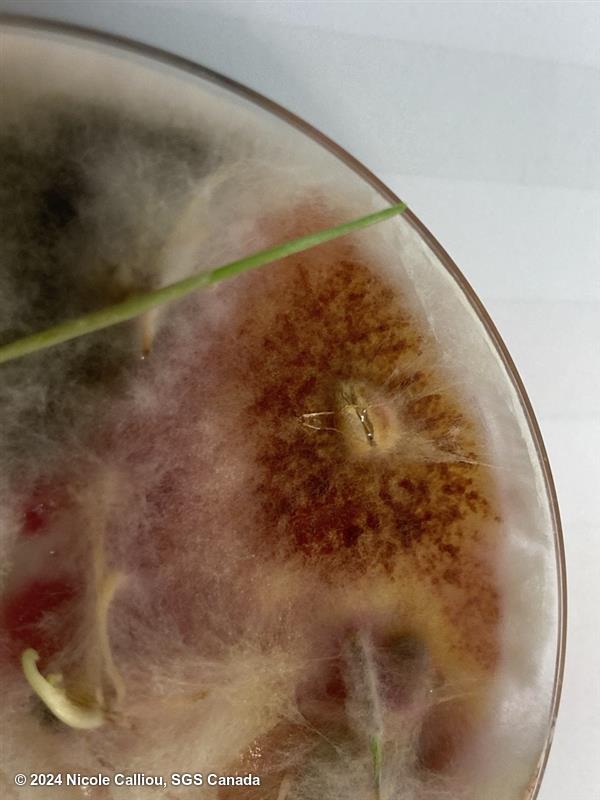
Fusarium cerealis on Triticum spp.
Image credits: Nicole Calliou, CA
Fusarium crookwellense is often confused with F. culmorum (due to their growth habits, and wide spores), but the spores should have a distinct foot cell, that is absent with F. culmorum. Also, they tend to be 5-7 septate (not 2-5 septate like F. culmorum).
sterilisation: 1% NaOCl 4 min | growth time: 5 days | temperature: 25+/-2C | lighting: 3:1 (fluorescent:nUV), within 60cm of light. Alternating light/dark in 12 hr intervals | plate size: 100mm | agar: PDA ( Neogen)
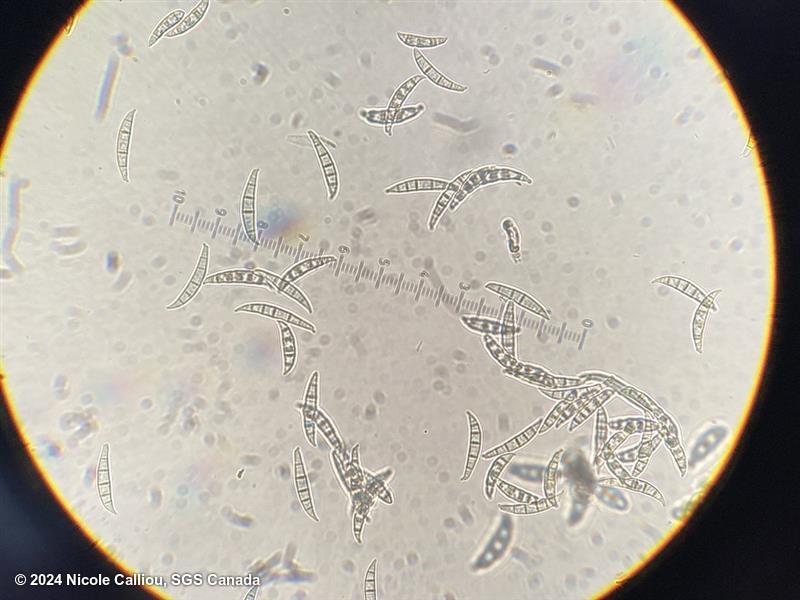
Fusarium cerealis on Triticum spp.
Image credits: Nicole Calliou, CA
Fusarium crookwellense is often confused with F. culmorum (due to their growth habits, and wide spores), but the spores should have a distinct foot cell, that is absent with F. culmorum. Also, they tend to be 5-7 septate (not 2-5 septate like F. culmorum).
sterilisation: 1% NaOCl 4 min | growth time: 5 days | temperature: 25+/-2C | lighting: 3:1 (fluorescent:nUV), within 60cm of light. Alternating light/dark in 12 hr intervals | plate size: 100mm | agar: PDA ( Neogen)