Fusarium culmorum on Triticum spp.
Image credits: Nicole Calliou, CA
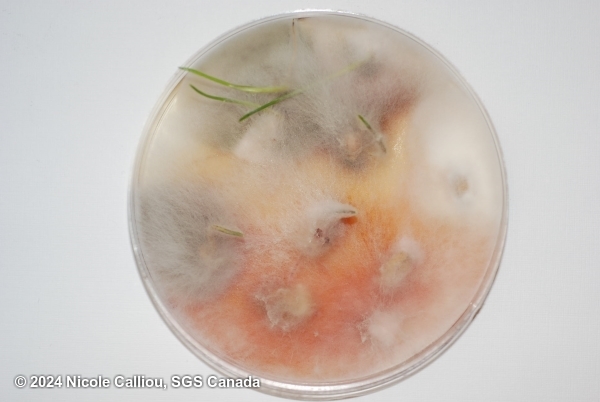
Typical fast growing Fusarium culmorum colony showing the orange coloration common on certain brands of PDA. Different brands can influence the coloration to be darker, almost red. Image 3 shows a close up of sporodochia which are also orange in color. Spores are commonly mistaken for F. crookwellense or F. sambucinum, but F. culmorum are usually 3-4 septate with a notched basal cell (no 'foot' shape), and the spores are very wide (often compared to maggots in our lab).
sterilisation: 1% NaOCl 4 min | growth time: 5 days | temperature: 25+/-2C | lighting: 3:1 (fluorescent:nUV), within 60cm of light. Alternating light/dark in 12 hr intervals | plate size: 100mm | agar: PDA ( Neogen) |
DNA testing: None
Fusarium culmorum on Triticum spp.
Image credits: Nicole Calliou, CA
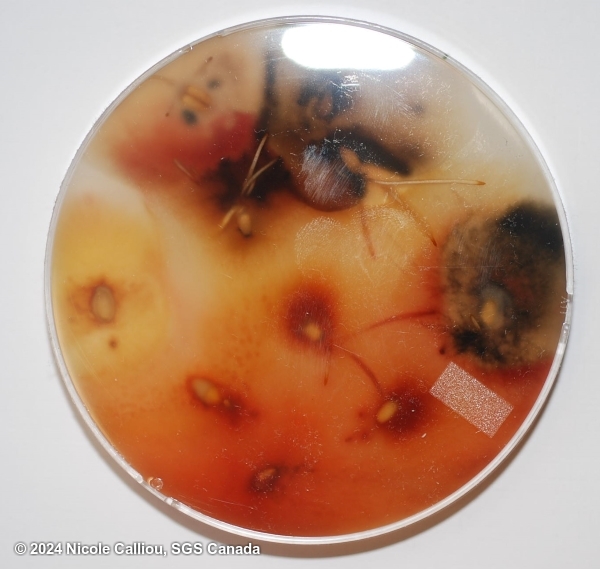
Typical fast growing Fusarium culmorum colony showing the orange coloration common on certain brands of PDA. Different brands can influence the coloration to be darker, almost red. Image 3 shows a close up of sporodochia which are also orange in color. Spores are commonly mistaken for F. crookwellense or F. sambucinum, but F. culmorum are usually 3-4 septate with a notched basal cell (no 'foot' shape), and the spores are very wide (often compared to maggots in our lab).
sterilisation: 1% NaOCl 4 min | growth time: 5 days | temperature: 25+/-2C | lighting: 3:1 (fluorescent:nUV), within 60cm of light. Alternating light/dark in 12 hr intervals | plate size: 100mm | agar: PDA ( Neogen) |
DNA testing: None
Fusarium culmorum on Triticum spp.
Image credits: Nicole Calliou, CA
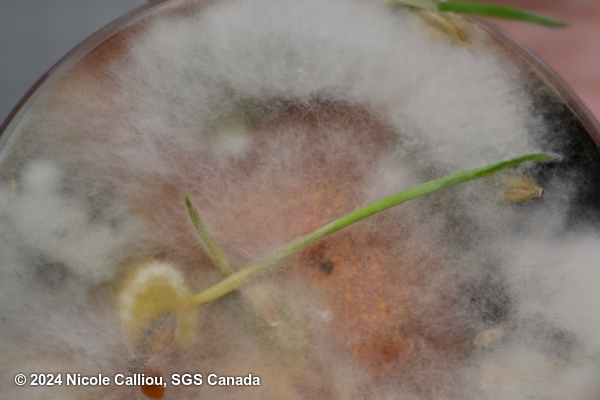
Typical fast growing Fusarium culmorum colony showing the orange coloration common on certain brands of PDA. Different brands can influence the coloration to be darker, almost red. Image 3 shows a close up of sporodochia which are also orange in color. Spores are commonly mistaken for F. crookwellense or F. sambucinum, but F. culmorum are usually 3-4 septate with a notched basal cell (no 'foot' shape), and the spores are very wide (often compared to maggots in our lab).
sterilisation: 1% NaOCl 4 min | growth time: 5 days | temperature: 25+/-2C | lighting: 3:1 (fluorescent:nUV), within 60cm of light. Alternating light/dark in 12 hr intervals | plate size: 100mm | agar: PDA ( Neogen) |
DNA testing: None
Fusarium culmorum on Triticum spp.
Image credits: Nicole Calliou, CA
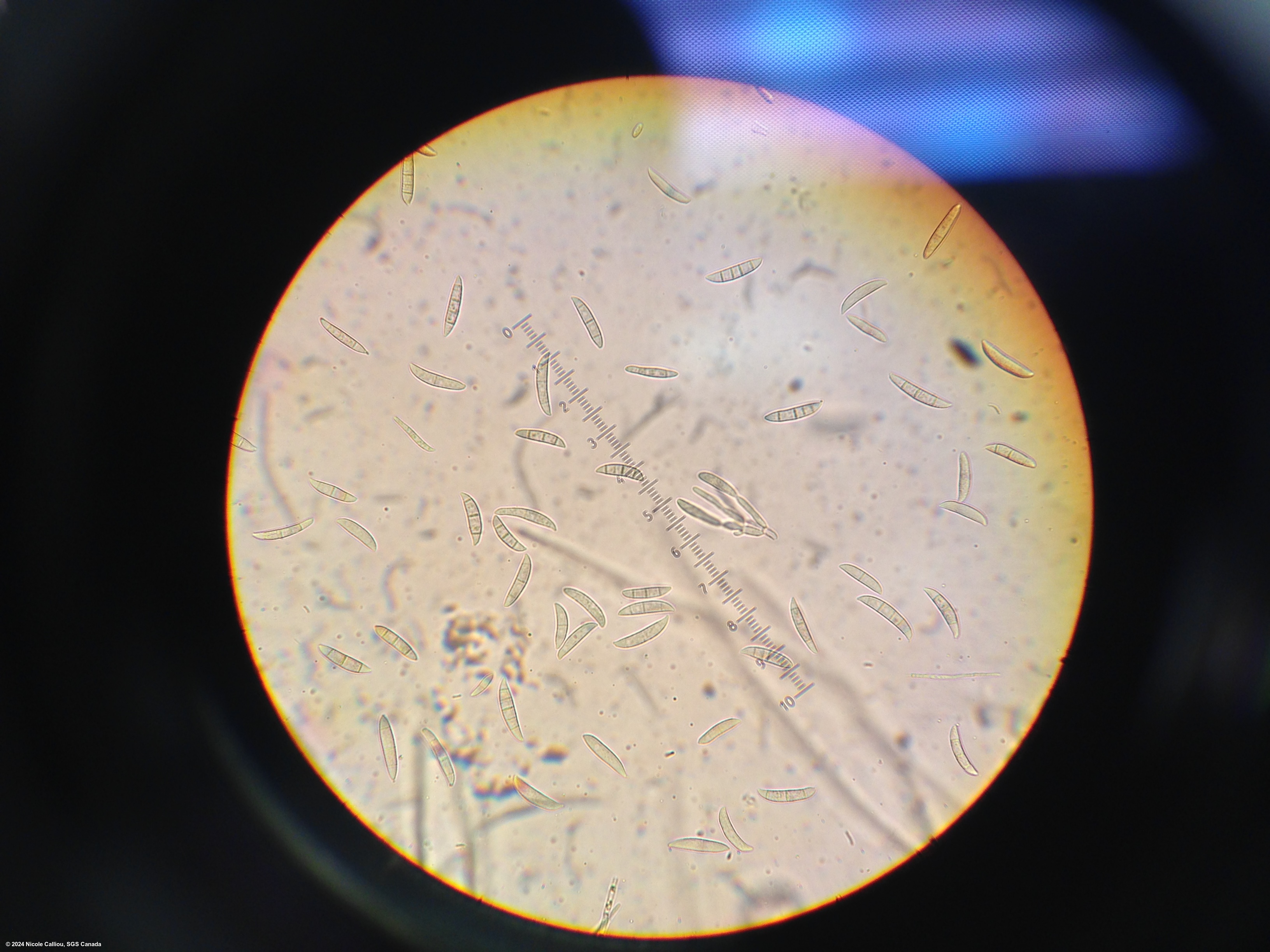
Typical fast growing Fusarium culmorum colony showing the orange coloration common on certain brands of PDA. Different brands can influence the coloration to be darker, almost red. Image 3 shows a close up of sporodochia which are also orange in color. Spores are commonly mistaken for F. crookwellense or F. sambucinum, but F. culmorum are usually 3-4 septate with a notched basal cell (no 'foot' shape), and the spores are very wide (often compared to maggots in our lab).
sterilisation: 1% NaOCl 4 min | growth time: 5 days | temperature: 25+/-2C | lighting: 3:1 (fluorescent:nUV), within 60cm of light. Alternating light/dark in 12 hr intervals | plate size: 100mm | agar: PDA ( Neogen) |
DNA testing: None
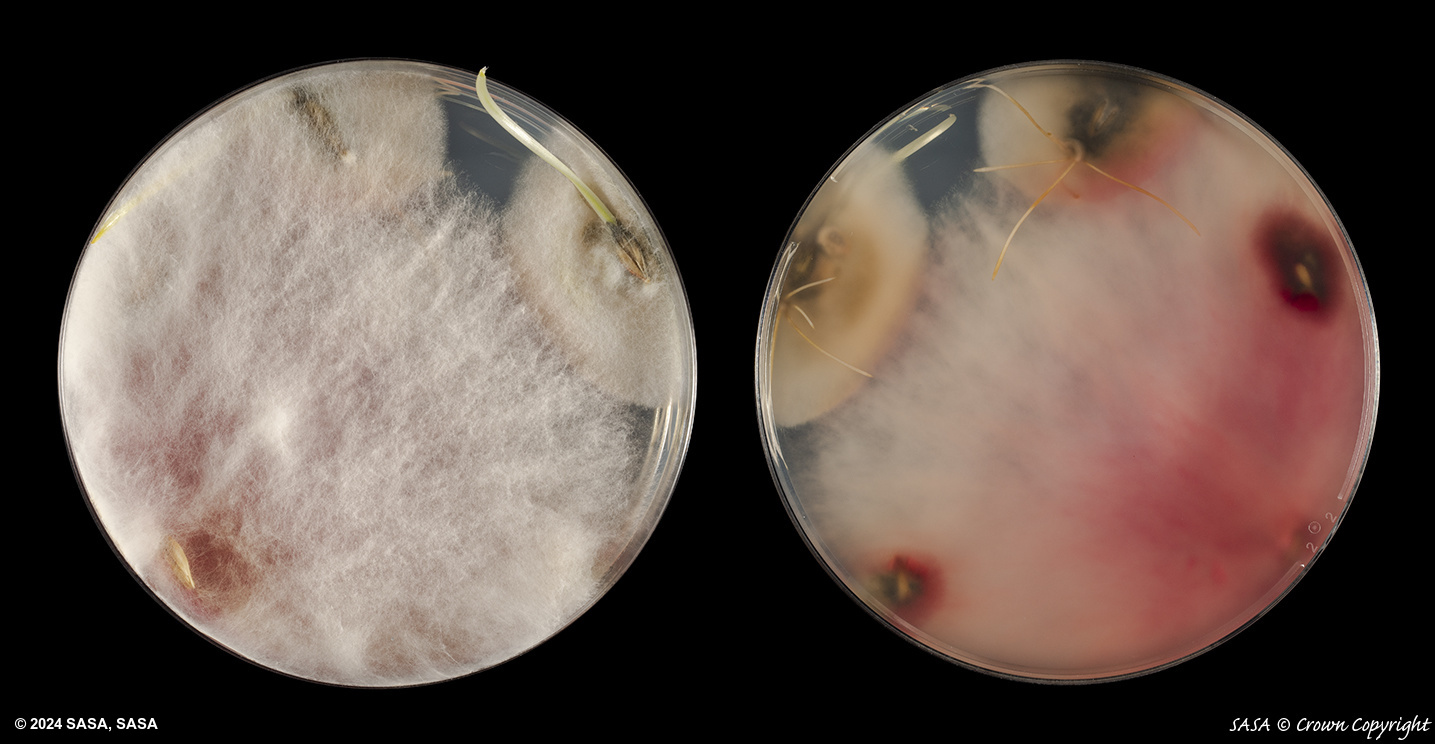
Fusarium culmorum on Hordeum vulgare subsp. vulgare
Image credits: SASA, GB
Fusarium culmorum from Hordeum vulgare seeds on Oxoid PDA, front and back images
sterilisation: NaOCl (1% available chlorine) 10 minutes | growth time: 7 days | temperature: 20C +/- 2C | lighting: Darkness | plate size: 90mm | agar: PDA ( Oxoid )
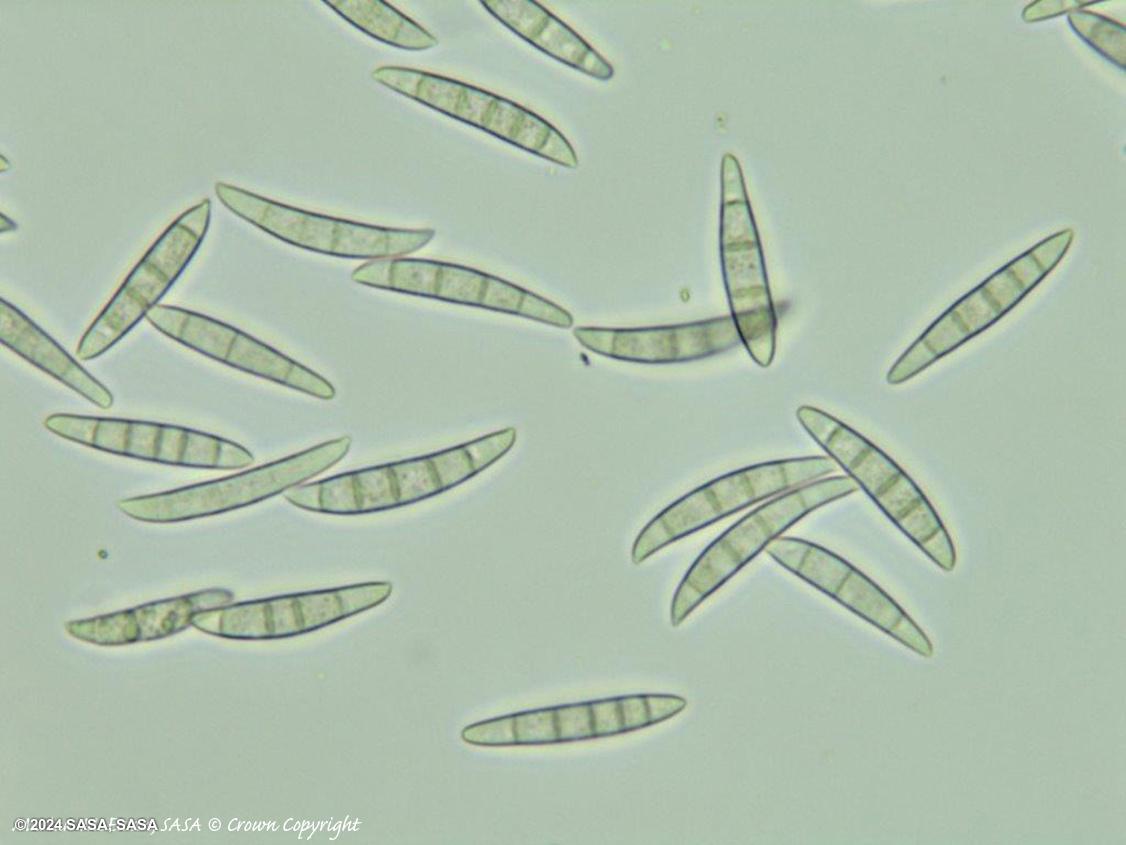
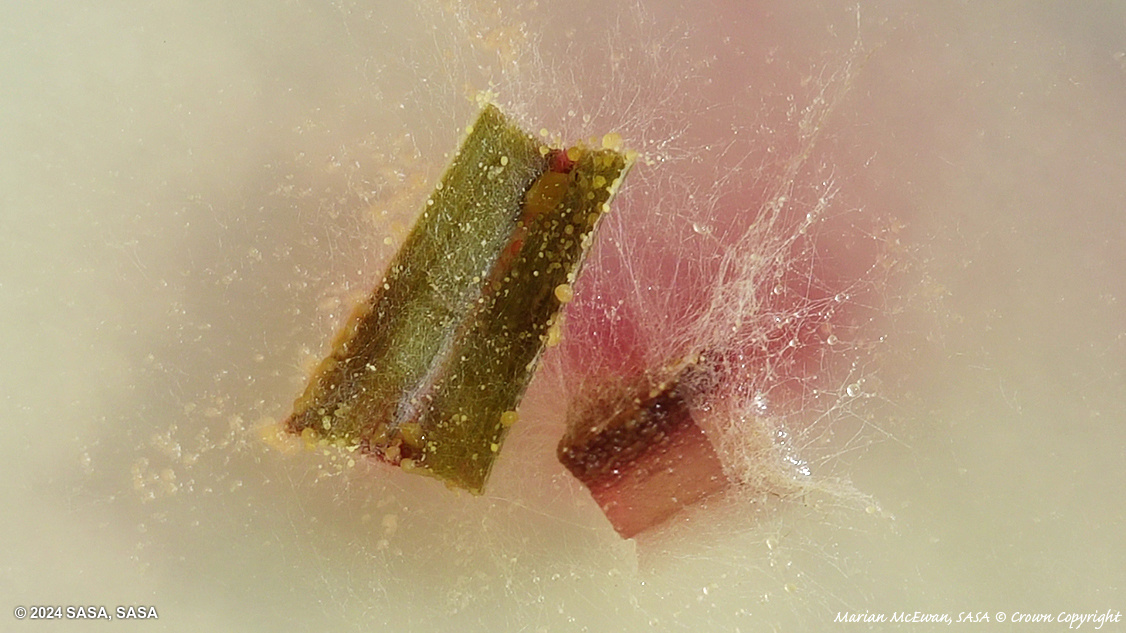
Fusarium culmorum on Hordeum vulgare subsp. vulgare
Image credits: SASA, GB
Fuarium culmorum sporodochia on carnation leaf on CLA
growth time: 3 | temperature: 20C +/- 2C | lighting: Darkness and supplementary NUV at 360nm to encourage sporulation | plate size: 90mm | agar: CLA (Oxoid Technical agar no3 with carnation leaves) ( Oxoid )