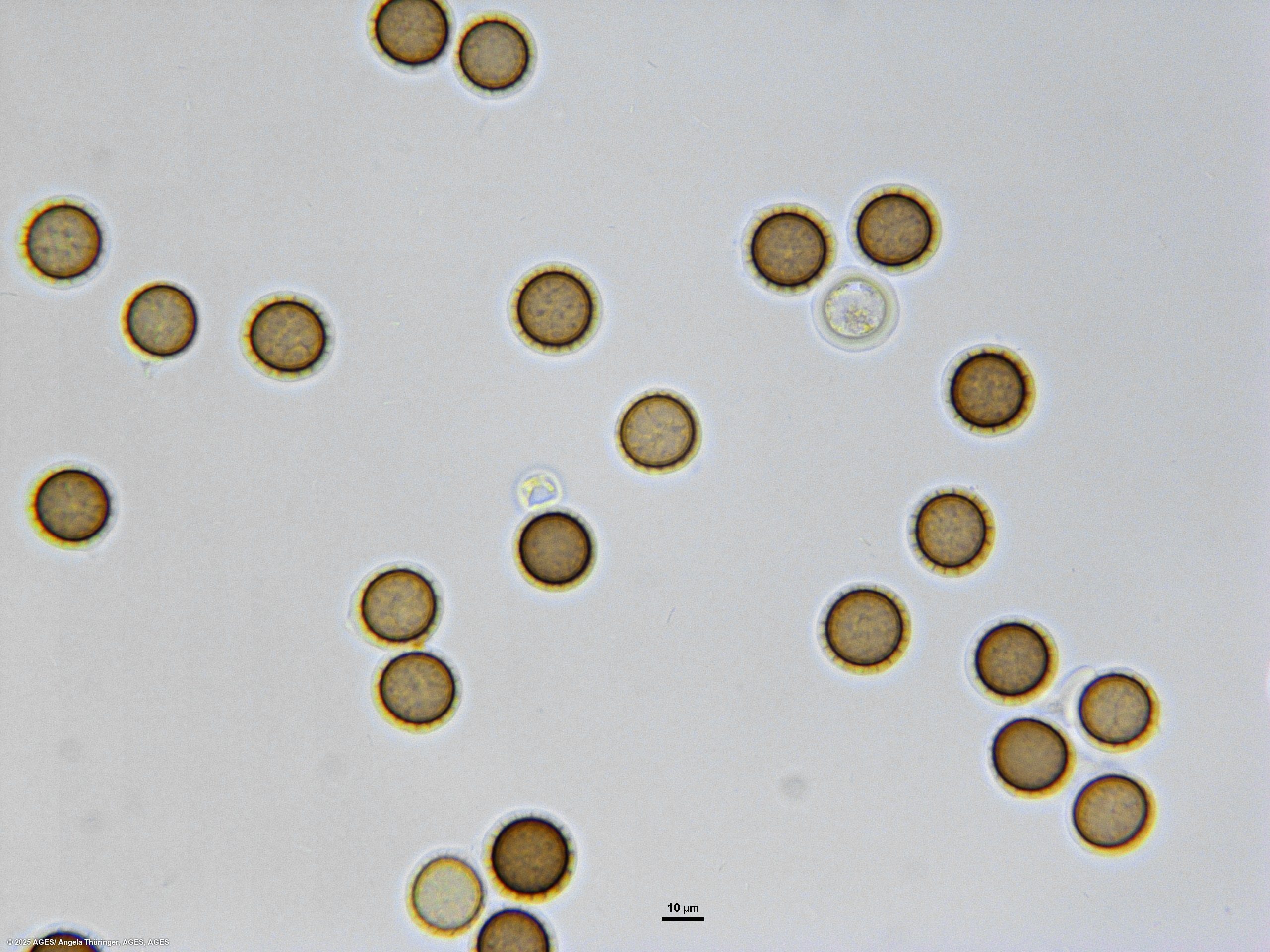
Tilletia controversa on Triticum spp.
Image credits: AGES/ Angela Thüringer, AGES, AT
Tilletia controversa (dwarf bunt) is a seedborne cereal disease with a high multiplication potential. Instead of seeds, bunt kernels are formed which are filled with millions of smut spores. The bunt spores are located on the outside of the grain, on the seed coat. Infected plants show a strongly stunted growth and are up to 2/3rds shorter than healthy plants. The bunt spores are thick-walled, globose to subglobose, with a high profile net-like surface looking like spikes on the outer surface, surrounded by a thin layer of mucus. The spores have a diameter of 17-23 µm and the colour is yellowish to reddish brown. Picture 1, 2 and 3: Spores of Tilletia controversa, 400x magnification. Picture 4 and 5: Spores of Tilletia controversa, 1000x magnification.
sterilisation: Washing Method ISTA Working Sheet No. 53 | plate size: 25mm diameter | agar: Cellulose nitrate filter ( Sartorius) |
DNA testing: No
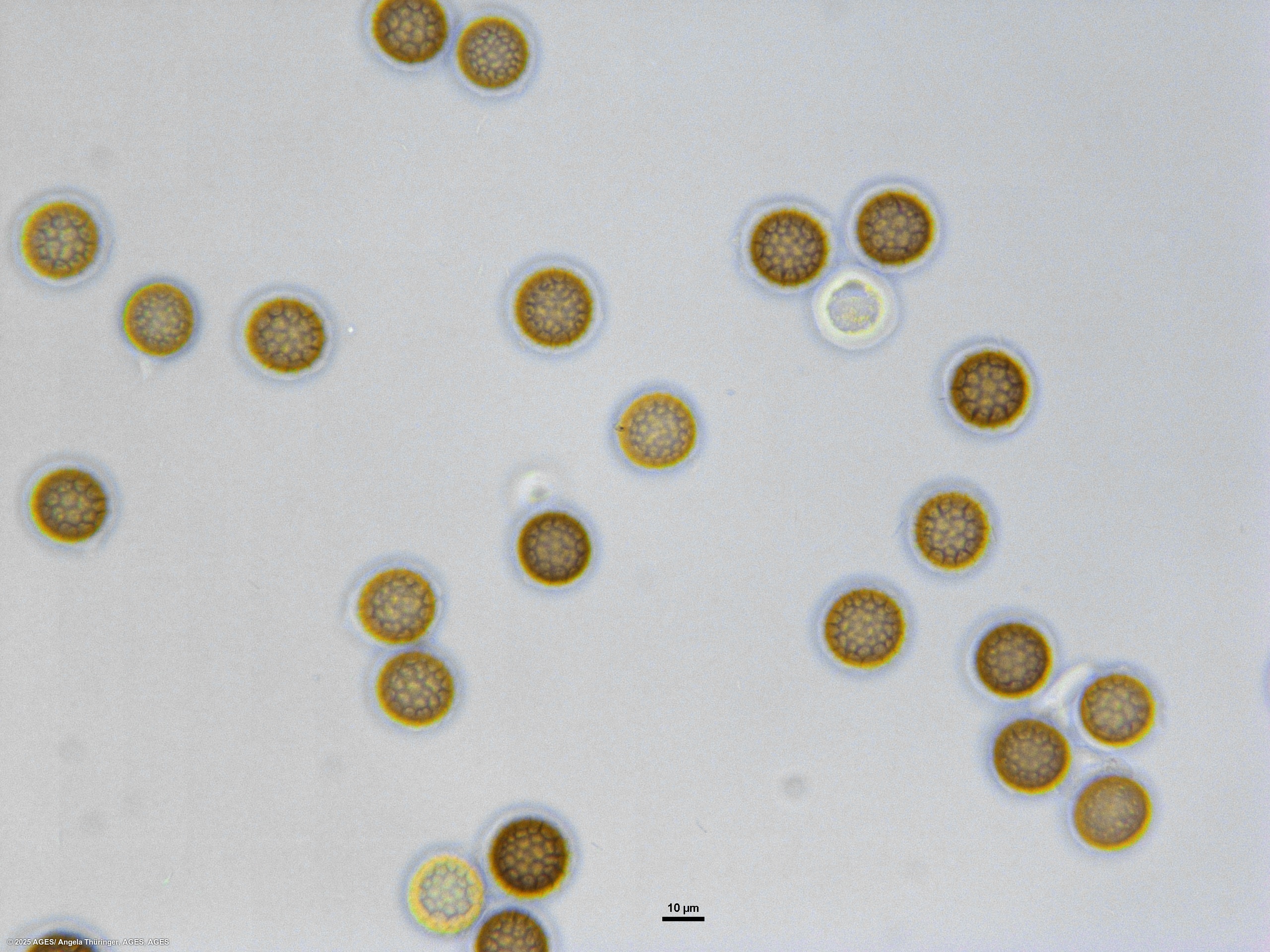
Tilletia controversa on Triticum spp.
Image credits: AGES/ Angela Thüringer, AGES, AT
Tilletia controversa (dwarf bunt) is a seedborne cereal disease with a high multiplication potential. Instead of seeds, bunt kernels are formed which are filled with millions of smut spores. The bunt spores are located on the outside of the grain, on the seed coat. Infected plants show a strongly stunted growth and are up to 2/3rds shorter than healthy plants. The bunt spores are thick-walled, globose to subglobose, with a high profile net-like surface looking like spikes on the outer surface, surrounded by a thin layer of mucus. The spores have a diameter of 17-23 µm and the colour is yellowish to reddish brown. Picture 1, 2 and 3: Spores of Tilletia controversa, 400x magnification. Picture 4 and 5: Spores of Tilletia controversa, 1000x magnification.
sterilisation: Washing Method ISTA Working Sheet No. 53 | plate size: 25mm diameter | agar: Cellulose nitrate filter ( Sartorius) |
DNA testing: No
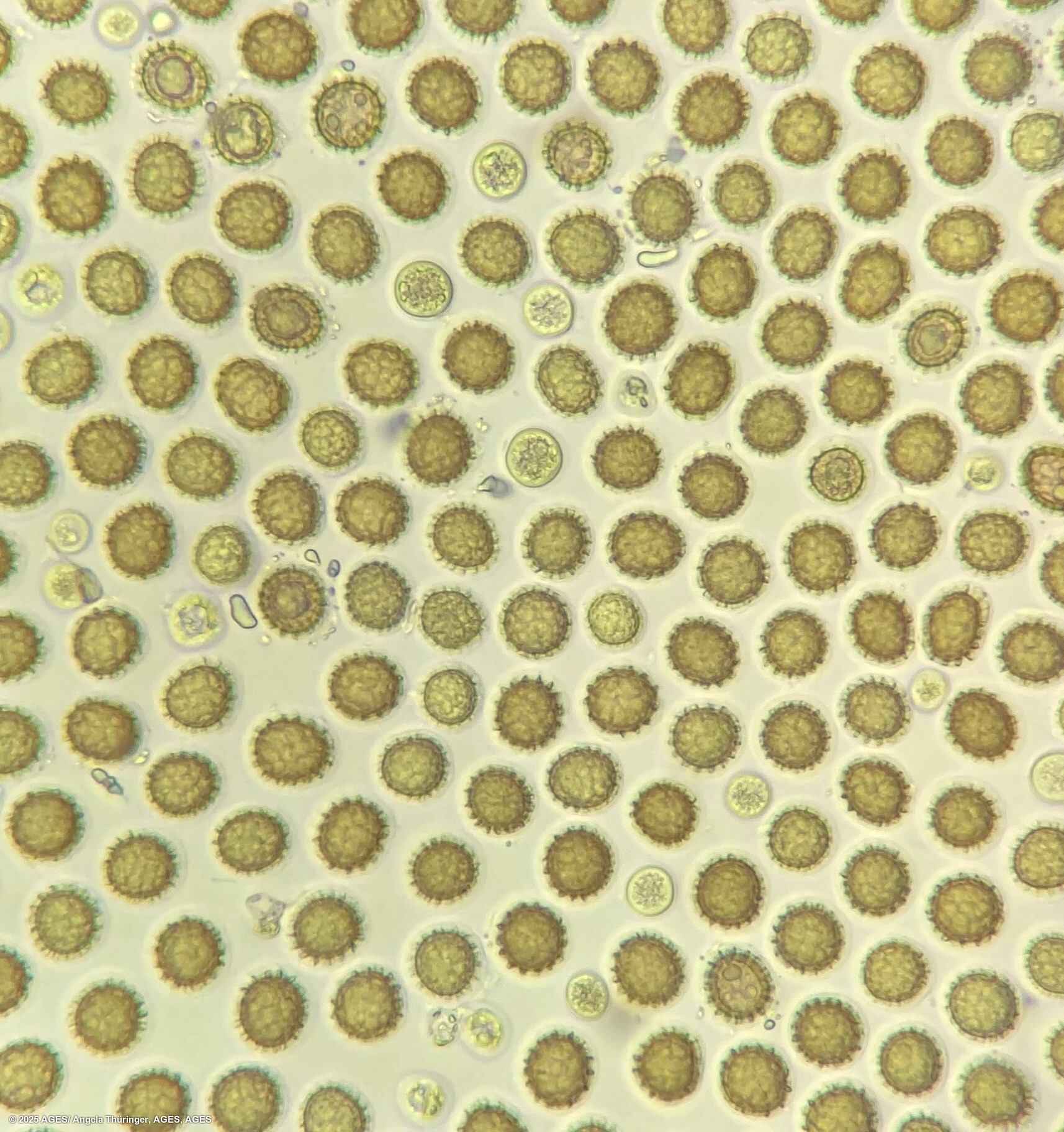
Tilletia controversa on Triticum spp.
Image credits: AGES/ Angela Thüringer, AGES, AT
Tilletia controversa (dwarf bunt) is a seedborne cereal disease with a high multiplication potential. Instead of seeds, bunt kernels are formed which are filled with millions of smut spores. The bunt spores are located on the outside of the grain, on the seed coat. Infected plants show a strongly stunted growth and are up to 2/3rds shorter than healthy plants. The bunt spores are thick-walled, globose to subglobose, with a high profile net-like surface looking like spikes on the outer surface, surrounded by a thin layer of mucus. The spores have a diameter of 17-23 µm and the colour is yellowish to reddish brown. Picture 1, 2 and 3: Spores of Tilletia controversa, 400x magnification. Picture 4 and 5: Spores of Tilletia controversa, 1000x magnification.
sterilisation: Washing Method ISTA Working Sheet No. 53 | plate size: 25mm diameter | agar: Cellulose nitrate filter ( Sartorius) |
DNA testing: No
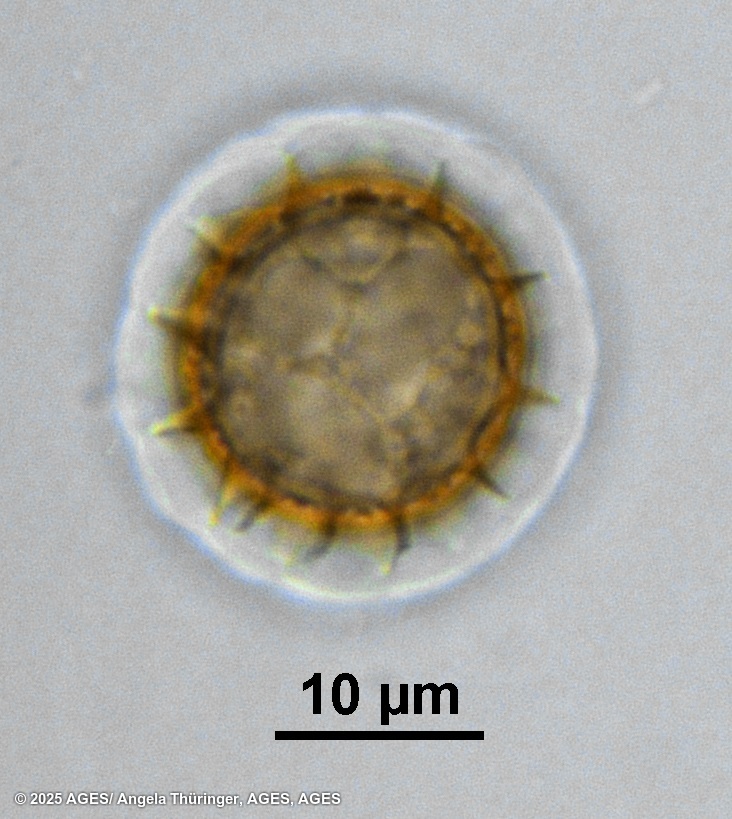
Tilletia controversa on Triticum spp.
Image credits: AGES/ Angela Thüringer, AGES, AT
Tilletia controversa (dwarf bunt) is a seedborne cereal disease with a high multiplication potential. Instead of seeds, bunt kernels are formed which are filled with millions of smut spores. The bunt spores are located on the outside of the grain, on the seed coat. Infected plants show a strongly stunted growth and are up to 2/3rds shorter than healthy plants. The bunt spores are thick-walled, globose to subglobose, with a high profile net-like surface looking like spikes on the outer surface, surrounded by a thin layer of mucus. The spores have a diameter of 17-23 µm and the colour is yellowish to reddish brown. Picture 1, 2 and 3: Spores of Tilletia controversa, 400x magnification. Picture 4 and 5: Spores of Tilletia controversa, 1000x magnification.
sterilisation: Washing Method ISTA Working Sheet No. 53 | plate size: 25mm diameter | agar: Cellulose nitrate filter ( Sartorius) |
DNA testing: No
Tilletia controversa on Triticum spp.
Image credits: AGES/ Angela Thüringer, AGES, AT
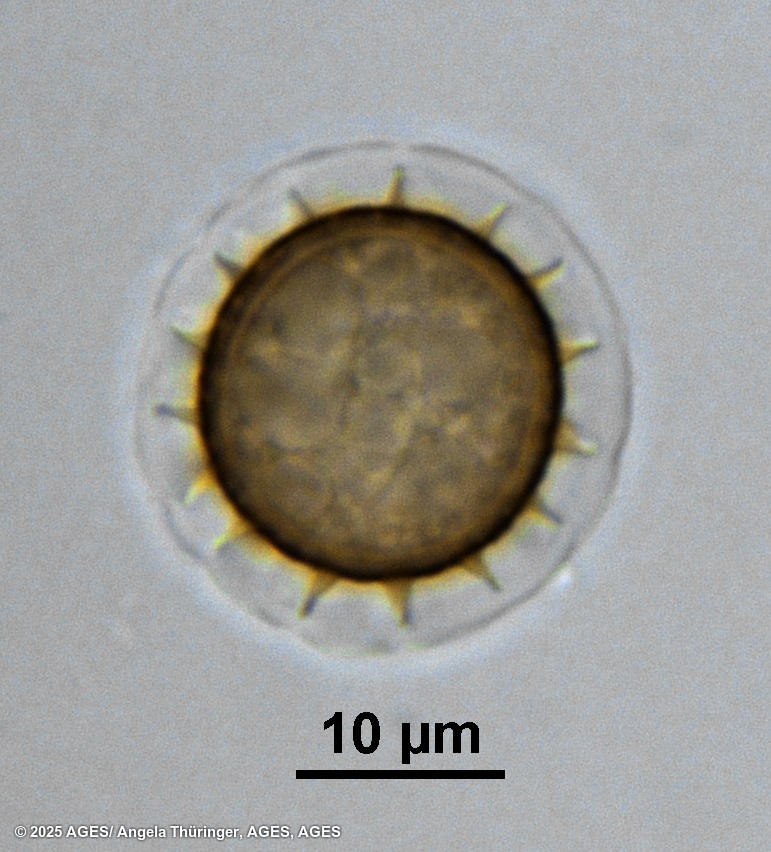
Tilletia controversa (dwarf bunt) is a seedborne cereal disease with a high multiplication potential. Instead of seeds, bunt kernels are formed which are filled with millions of smut spores. The bunt spores are located on the outside of the grain, on the seed coat. Infected plants show a strongly stunted growth and are up to 2/3rds shorter than healthy plants. The bunt spores are thick-walled, globose to subglobose, with a high profile net-like surface looking like spikes on the outer surface, surrounded by a thin layer of mucus. The spores have a diameter of 17-23 µm and the colour is yellowish to reddish brown. Picture 1, 2 and 3: Spores of Tilletia controversa, 400x magnification. Picture 4 and 5: Spores of Tilletia controversa, 1000x magnification.
sterilisation: Washing Method ISTA Working Sheet No. 53 | plate size: 25mm diameter | agar: Cellulose nitrate filter ( Sartorius) |
DNA testing: No