Parastagonospora nodorum
Overview
|
Scientific name
|
Parastagonospora nodorum |
|
Genus
|
Parastagonospora |
|
EPPO code
|
LEPTNO |
|
Common name
|
Septoria spot blotch or Glume blotch |
|
Synonyms
|
Septoria nodorum |
Description
From ISTA method 7-014:
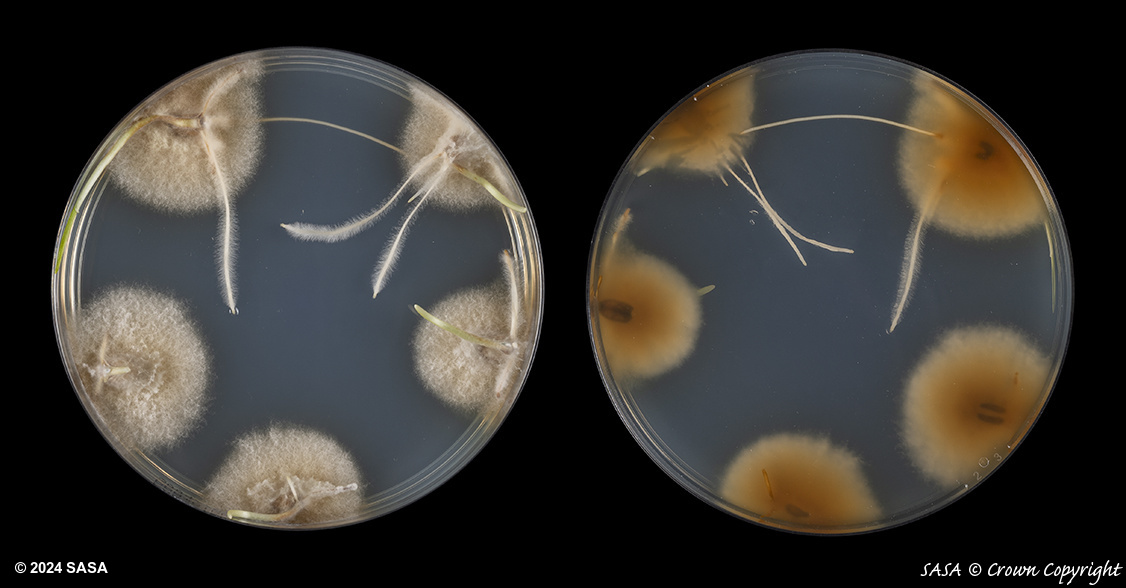
After 7 days of growth in an appropriate chamber, observe each seed for presence of slow growing circular colonies of dense white or cream mycelium that will often cover the infected seeds. Colony reverse is yellow/brown becoming darker with age.
From ISTA's Common Laboratory Seed Health Testing Methods for Detecting Fungi:
White to grey, loose, fluffy mycelium, which is characteristic of the fungus, develops on seed and in most cases without the formation of oycnidia. Whenever pycnidia develop, they are observed mainly on the filter paper below and around the seed. They appear almost transparent, sometimes with more than one ostiole. Rarely pycnidia may be produced on the seed. The ooze of pycnidiospores is pinkish.
Pycnidiospores hyaline, 1-3 septate, cylindrical, 15-32 x 2-4μm.
Images of Parastagonospora nodorum
Parastagonospora nodorum on Triticum spp.
Image credits: SASA, GB
PDA plate showing slow-growing circular colonies of dense white or cream mycelium that often covers infected seeds. The reverse of the colony is yellow/brown becoming darker with age.
sterilisation: 1% NaOCl 10 min | growth time: 7 days | temperature: 20 +/- 2C | lighting: Darkness | plate size: Unknown | agar: PDA agar ( Oxoid) |
DNA testing: None